
By Sadie Kolodner
Whether he is speaking on stage for the Student Sustainability Council or sending emails about the Just Food Club, you probably recognize Chase Talpins ‘27 as one of the loudest advocates for sustainability at RCDS.
Talpins’ love for sustainability sprouted from the kitchen. Since the pandemic, he has been exploring different recipes and cuisine for his family, which led him to develop an interest in food, food waste, and food insecurity. As he researched this passion, he grew to understand sustainability issues and how they intersect with food waste. Along the way, he credited all of the Rye Country Day teachers who bolstered his passion, including Director of Sustainability Ms. Linderoth, who supported all of his sustainability endeavors.
Talpins describes sustainability as “one of the most pressing challenges that we face today.” He said, “We are the next generation to change and be in the work force, so making sure we understand the sustainability challenges can help inspire people to make change in the future.” This belief led Talpins to create the Just Food Club as a freshman; his goal for the club was to increase education around food waste and food insecurity, and to generate solutions to those issues accessible to our school community. Talpins serves as president alongside Vice President Maddie Stokes ‘28, Secretary and Data Analyst C.C. Liu ‘28, Treasurer Christopher Estill ‘28, Community Outreach and Feeding Westchester Coordinator Eda Buyuk ‘27, and Social Media Manager Mia Shimada Ling ‘28.
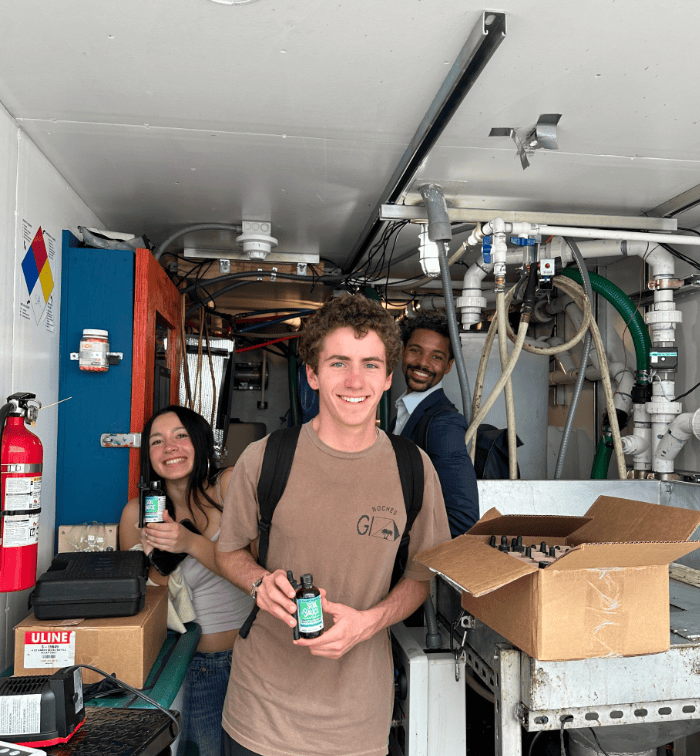
Under his leadership, the club received a Garden Grant from the Whole Foods Foundation, which allowed them to expand garden infrastructure on campus. During the month of October, the club runs the campus-wide Food Waste Challenge, where each division (Lower, Middle, and Upper School) compete against each other to have the least food waste. Talpins, however, described their most notable project as “Close The Loop.” It was designed for the Bedford 2030 Greenlight Award and earned them the 2nd place title. The project created a circular food system on campus: food scraps from the kitchen go into the ZEUS anaerobic digester, then what comes out of the digester feeds the garden, and what grows in the garden makes its way back into the kitchen. The last step of the circle is bringing the topic of sustainable food systems and the ZEUS digester into the classroom. As of April 2026, this project has kept over 22,809 pounds of waste out of the landfills.
While Talpins celebrates these accomplishments, he also acknowledges the club’s failed initiative. Talpins explained how the club “tried to establish a community-supported agriculture (CSA) program at school, where parents and faculty could sign up to pick up boxes of fresh produce from local farms weekly or monthly.” Despite their effort, they were not able to fully develop and get the program off the ground. However, the experience gave Talpins a greater understanding of how difficult it is to improve food systems on a larger scale.
During the 2026/2027 school year, Talpins hopes to expand the Just Food Club’s current initiatives, while also building a new system where club members can pursue their own sustainability projects with the club’s support.
Talpins’ most recent initiative is the Student Sustainability Council, which he helped found with Linderoth, the school administration, and other RCDS students. The group saw the need for a lasting structure, one “that gives students a voice in sustainability efforts and consistent support for their projects.” Talpins’ hope is that “the council becomes an enduring part of our school, helping students launch sustainability initiatives and giving them the support to follow through.”
After graduation, Talpins hopes to study STEM in college and explore “how scientific advances, particularly in biotechnology, can address food waste and other food system challenges.” Eventually, he wants to become an entrepreneur, who can turn those discoveries into practical solutions and create a meaningful impact.
For students not interested in taking on a sustainability project, Talpins described small everyday changes that still make an impact. These include participating in the Food Waste Challenge and properly sorting lunch into the correct bins (e.g. compost, recycling, waste, etc.). Students can also attend a Just Food Club meeting to learn more about sustainability. This may seem small, but as Talpins describes, “the culmination of all of your small changes can help make a difference in the world.”

