
By Emily Hau
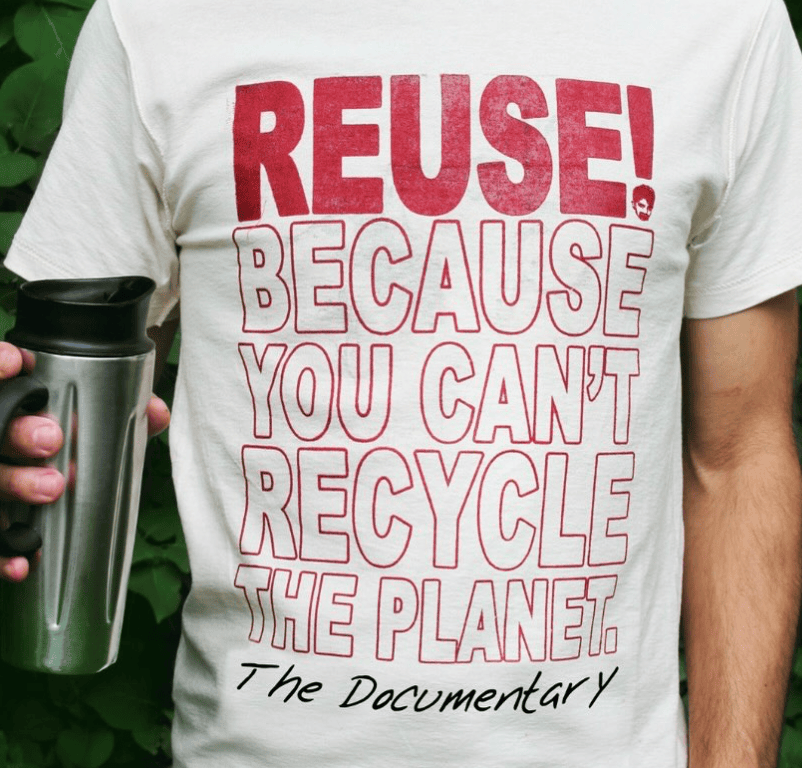
Have you ever thought about how much trash you throw away on any given day? It’s probably re than you think. According to the U.S. Environmental Protection Agency (EPA), the average person throws away 4.9 pounds of waste every day, which is nearly 1,800 pounds each year. To combat this, Alex Eaves founded Escape the Waste, an organization that uses edutainment—entertainment that is educational—to highlight how the worldwide waste problem can be tackled through reusing. His documentary, REUSE! Because You Can’t Recycle The Planet was shown at the annual Green Screen event on October 22 at RCDS. The documentary follows Eaves’ adventure across 48 U.S. states where he finds innovative reuse solutions and interviews local experts.
The Green Screen is an annual public event co-organized by the RCDS Sustainability Program and the Rye Sustainability Foundation. It was founded in 2011 and highlights an uplifting environmental film and a guest speaker related to the film each year. The event helps raise awareness about environmental issues and demonstrates how people can take action in their daily lives. Mrs. Linderoth, the Director of Sustainability at RCDS who helps organize the event, added enthusiastically, “It’s great to have a lot of community partners here and people from the Rye community.”
The event incorporates a Zero Waste Reception before the screening of the film, where Flik provides delicious finger foods. No plates or utensils are wasted, and RCDS composts all leftover food in the ZEUS digester. Linderoth noted, “We try to make it a truly sustainable event.”
The event has evolved, as Linderoth described: “Over the years, we’ve incorporated a lot more student involvement and engagement.” During the Zero Waste Reception, students present projects related to sustainability and the film being shown. This year, tying into the topic of reusing, Charley Kercher ‘28, Madeleine Stokes ‘28, and Natalie Zhu ‘28 presented their project Fleaconomy. Fleaconomy was their Greenlight Award project in 2025, for which they received an honorable mention for outstanding school community engagement. The Greenlight Awards are an annual competition where teens in the Westchester area create and implement sustainable solutions in their community. Fleaconomy tackled the problem of overconsumption by creating a clothing swap. According to Zhu, they wanted to “promote a more circular economy, where clothes are reused rather than constantly bought and discarded.” The clothing swap has grown and now includes the Halloween Boo-tique, where students and faculty can donate and find used Halloween costumes and accessories. The Boo-tique was open for attendees to visit during the event.
During the Zero Waste Reception, Eaves’ sustainable tiny house was stationed on-campus for tours. The house was built under the guidance of tiny house expert Deek Diedricksen, who helped Eaves convert a truck into a functioning house. Diedtrickesen and Eaves created a documentary on the building of this house called The Box Truck Film: Building A Reuseful Home which was presented at the Green Screen two years ago. Eaves’ tiny home is built from entirely upcycled materials, which he found by dumpster diving and visiting old construction sites. Eaves intentionally avoided buying new appliances and materials as he built his tiny home, even turning an old lobster pot into a sink. The organizers chose to show Eaves’ second film this year not only because of the opportunity to have the tiny house back on campus, but because of the relevance of reusing at RCDS. For example, the film’s themes connect to the Makerspace, where materials are reused and upcycled in student projects, as well as the overall school community. Linderoth emphasized, “There are so many materials that we use every single day here at school—if we can think about the lifecycle of that product, and where it goes when it’s no longer being used, is there a way to think more creatively about that item? Instead of putting it into the waste stream?”
After thirty minutes of tiny house tours, student presentations, and Flik food, the night moved into the Black Box where the film was shown. Following the film, there was an exciting Q&A with Eaves and Diedricksen. Reflecting on the evening, Linderoth enjoyed the Green Screen because, as she put it, “I love seeing everyone in the community come together and learn from each other, learn from experts and engage in sustainability related topics, and leave feeling empowered to take action in their everyday lives.” This year’s Green Screen reminded RCDS that small actions and thoughtful changes in habits can ultimately create a more sustainable community.

