
Written by Alexandra Steyn
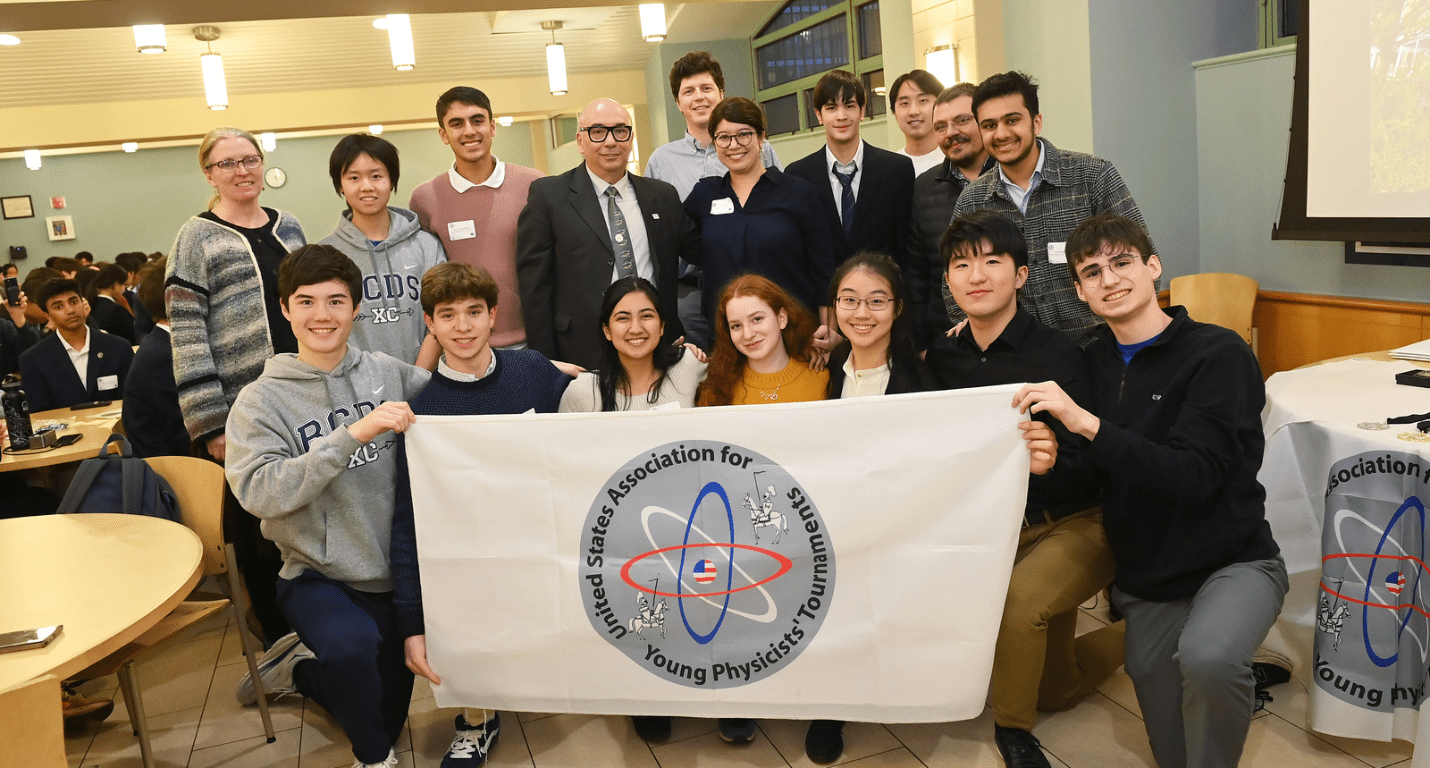
On February 1st and 2nd, 16 schools convened on Rye Country Day School’s campus to take part in the 2025 Young Physicists Tournament (YPT). Rye Country Day’s YPT Team, which meets 4 Z blocks per cycle, started preparing for the tournament last April, after returning from a triumphant 2024 tournament where they won first place. The tournament requires each team to tackle four problems, which are announced at the end of the previous year’s competition. For 2025, the problems ranged from the interactions of Sonic Sound Sizzler Magnets to the stability of jello as a building material. To divide the work equally, YPT split into three teams of around seven students each and put their physics minds to the test. However, solving the problems is only part of the challenge.
In addition, each team must prepare presentations that detail their solutions in an engaging and logical way. Because not every student on the 27-person team can participate in the live competition, their travel team, consisting of 12 students, was chosen to stay on campus during the competition, and three of those students were chosen to present: Jaymin Ding ’25, Davis Clarke ’25, and Alyssa Chu ’25. These students joined the other schools on the RCDS campus to present, learn, and solve. Referring to the in-person presentations, Ding explained, “Public speaking skills are important for creating a good impression when presenting.” He recalled their sessions leading up to the competition when members drilled each other on their presentations and practiced several times.
During their sessions, YPT students engaged in a variety of activities to prepare. Early on in the process, they dedicated their time to reading papers and discussing possible approaches to their problems. Upper School Chemistry teacher Mr. Burt, one of the team’s faculty advisors in addition to Upper School Physics teachers Dr. Krasovec and Dr. Bove, mentioned some of the questions they tackled initially: “How could you test this? What are the key parts of this problem? How do we divide that work amongst our team?” As the competition approached, they switched to physically implementing their experiments and calculating formulas. Ding added that they worked on “understanding the theory and preparing experiments to present at the tournament,” so that they could talk as experts and easily respond to questions.
The competition started on Saturday morning with a keynote speech from Michael Massimo, former NASA astronaut, Professor of Mechanical Engineering at Columbia University, and Senior Advisor of Space Programs at the Intrepid Sea, Air & Space Museum. Following his speech, teams faced off in five one-hour rounds. In these rounds, two teams compete against each other before a panel of judges. One team challenges the other to a problem, forcing the opposing team to present on that problem for ten minutes. The challenging team then questions the opposing team about their presentation and later presents their own approaches to the same problem. A panel of judges, composed of PhD and professional physicists, questions both teams after their presentations.
On Sunday, after two more rounds, 5 finalist teams, with RCDS among them, were announced. These finalist teams then faced off in four more rounds, followed by a final compiling of the scores. RCDS placed third place with a score of 77.60, after which came Phillips Andover Academy with a score of 78.68, and in first place Cary Academy with a score of 79.14.
However, YPT is much more than simply a competition students hope to win. Ding shared, “One of the most important things I’ve learned from YPT is the idea of scientific discussion,” and added that he developed his ability to “engage in a respectful, productive scientific discussion” through YPT. Mr. Burt agreed, citing the importance of “open-ended science problems.” He said, “It’s a great way to both learn physics, learn teamwork, and try to practice different perspectives within science,” a unique experience offered to RCDS physics students.
Additionally, a key aspect of YPT’s appeal is its international scope, drawing schools from Kyrgyzstan and China. Ding said that his favorite part of the tournament was “seeing how the other teams approached the same problems.” Given the number of teams, there was certainly a variety of unique approaches highlighted at the competition, and meeting those teams and learning about their solutions were certainly highlights. Mr. Burt added that his favorite part of YPT is “when the students finally have it all together,” which allows students to form a “cohesive understanding of the problem” after testing various approaches for so long.
Congratulations to all the teams in the 2025 Youth Physics Tournament, and good luck to the YPT team as they embark on their next physics journey: the 2026 tournament!

