
By Georgina Murphy
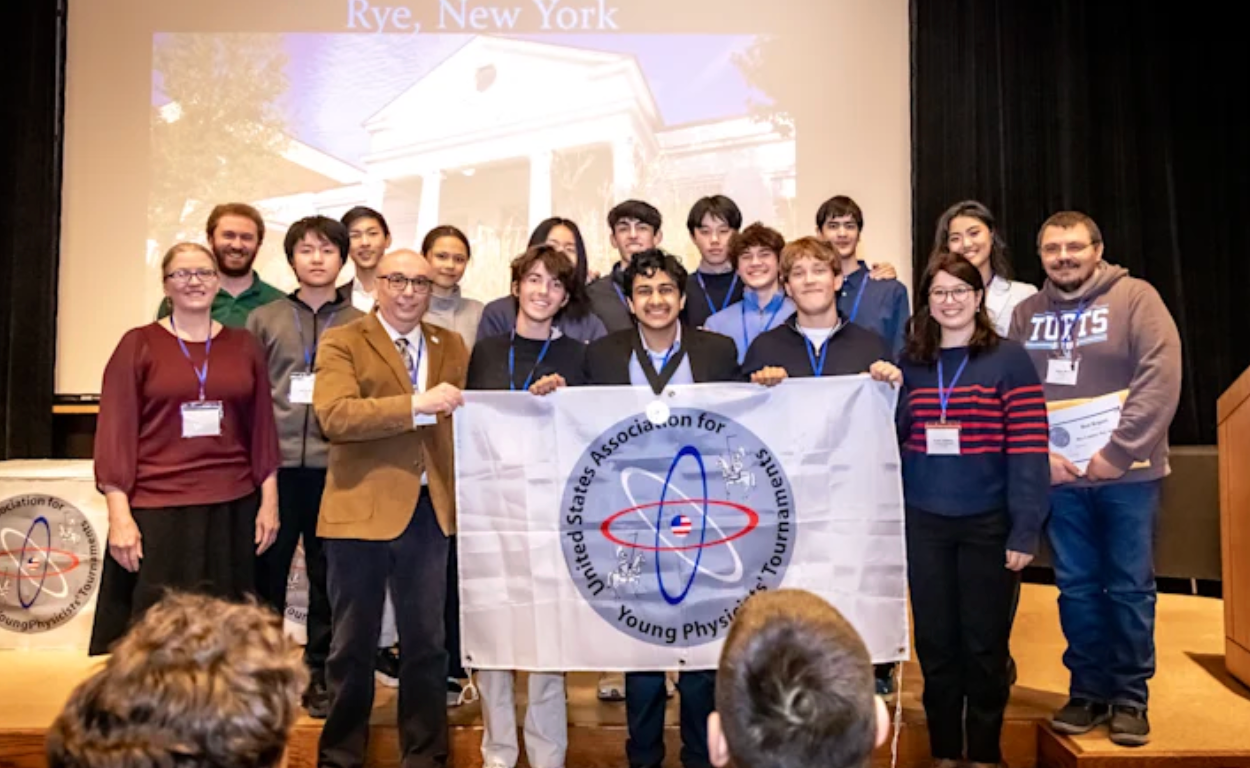
From January 31st to February 1st, the Young Physicists Tournament, also known as YPT, was held at Phillips Academy in Andover, Massachusetts. YPT is an international, team-based physics competition for high schoolers and young physicists. This year, RCDS competed against fifteen schools, including Philips Exeter, Philips Andover, the Trinity School, the Nueva School, and the George School. Throughout the month leading up to and at the tournament, the different high school teams solve open-ended physics problems through theory and experimentation. Although each school receives the same four problems, each team has a different approach to the problem. Charles Iwanski ‘26 explained that while there is no correct answer to any of the problems, teams must be able to defend their position and approach.
This year, the problem was to model the photometry—the science of measuring light, specifically how it is perceived by the human eye—of a flash bulb by measuring the temperature inside the filament and the surface area over time. RCDS YPT members approached this problem by using black body radiation. Member of YPT, Alison Gipstein ‘28 says that, “Black body is basically an ideal object, meaning it doesn’t exist and is theoretical but real objects can get really close, think like an ideal gas that absorbs all the light that hits it. But the light it emits is purely based on the temperature and thermal energy, even though it takes the form of electromagnetic energy. So the light you detect — the black body radiation — is actually indicative of temperature and not anything else.” If someone has something lower in temperature, the object will emit a red light, but if that object is higher in temperature, it will emit a more blue light. RCDS YPT members also used diffraction to split the light to different wavelengths and through light sensors, and what they found was that the temperature did not change over time.
Illaria Liedtke ‘27 explained that what differentiated RCDS from other schools is that the other schools made incorrect assumptions and came to the conclusion that the temperature changed over time, which is why the light bulb dimmed or brightened. However, RCDS students investigated the filament and discovered that the surface area of the filament changed over time, which can be attributed to the change in light.
The two main aspects of the YPT competition is presenting and scouting. Each YPT team can bring twelve people to the competition; four of these students are presenters and the other eight are scouts. This year’s presenters for RCDS were Chaaranath Badrinath ‘26, Michael Gomes ‘27, Tyler Hatstadt ‘26, and Andrew Eason ‘26. Scouting is where the other people can go and watch other teams’ presentations to try and find their solutions to their problems, so that they can try and find mistakes in the other team’s problem solving.
The final scores for the competition was RCDS with 88.97 points, the Nueva School with 87.46 points, Harker Schools with 86.99 points, Phillips Exeter School with 86.70 points, Phillips Academy Andover with 86.66 points, and the Woodberry Forest School with 86.22 points, handing RCDS a solid first place victory.
Congratulations to RCDS YPT and all of their hard work! The team’s focus now turns to next year’s YPT competition, which will be held at the California Institute of Technology in Pasadena, California.
 RYE CROP