
Alexandra Steyn
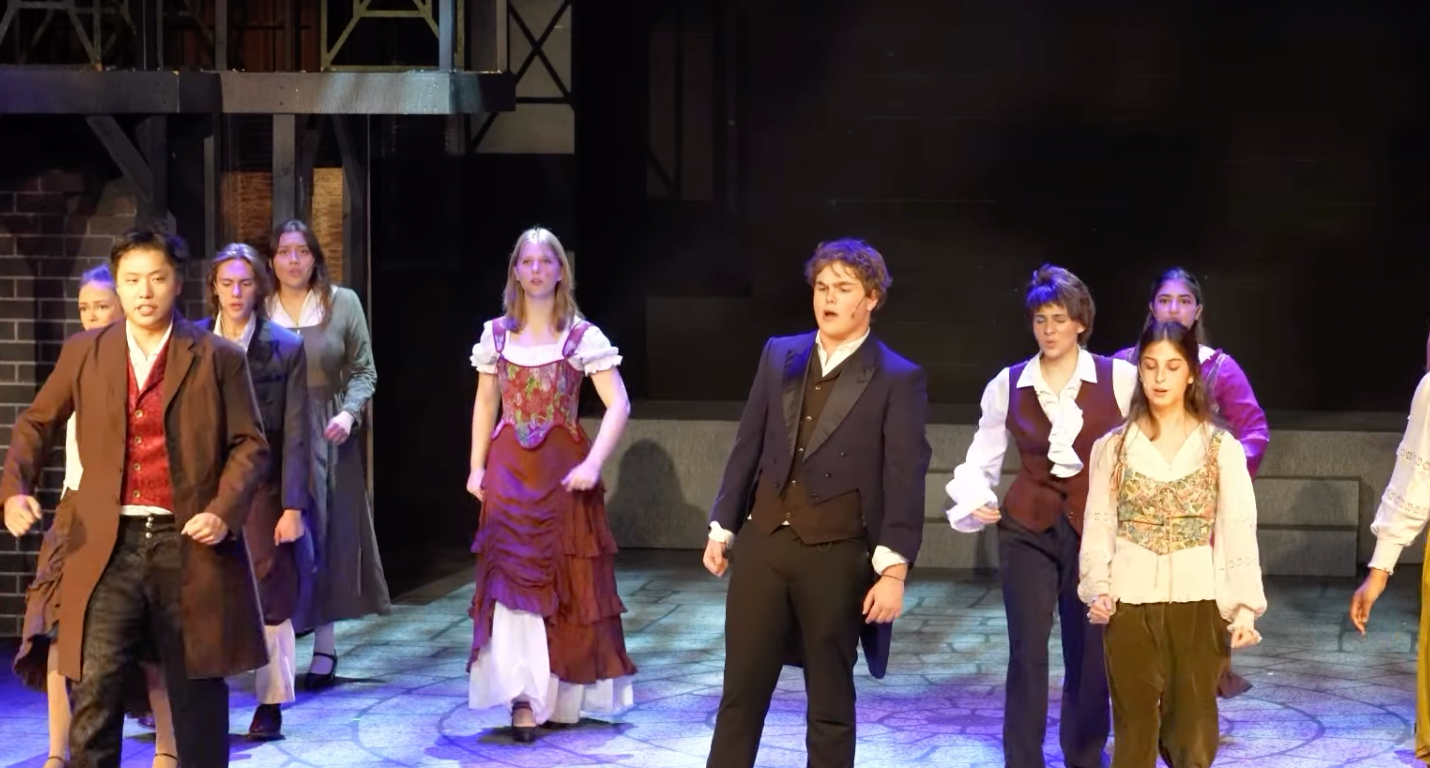
This year’s musical Les Misérables shone on the Dunn Performing Arts Center stage. An adapted, sung-through stage version of Victor Hugo’s novel of the same name, Les Misérables featured a cast of 27 students and performed for three consecutive nights. It opened on Thursday, February 5 at 5 p.m., followed by two packed evening performances at 7 p.m. on Friday and Saturday.
Traversing decades between 1815 and the 1832 Paris student uprising, Les Misérables follows the tale of Jean Valjean (Jacob Fisch ‘27), an ex-convict who escapes the claws of Inspector Javert (Chaim Sciamma ‘27) only to be caught in the throes of the early French Revolution. With Javert close on his heels, Valjean encounters Fantine (Vree Tuncer ‘26), a dying mother, who hands her daughter Cosette (Lydia Sussman ‘26)—hitherto under the care of innkeepers Monsieur and Madame Thérnadier (Teddy Kroin ‘28 and Haley Millowitz ‘27)—to his care. Skipping a decade ahead, the musical finds Cosette in love with Marius (Peter Valenton ‘27), a young, idealistic revolutionary, as his friend Éponine (Dominique Alvarez ‘26) yearns for his love. Ultimately, the students’ revolution fails, but Cosette and Marius marry happily as Valjean joins Fantine in his death. With a mix of high-energy group numbers and haunting, melodic solos of love and loss, the musical ends on a positive, reflective note despite its many deaths and sorrows.
The first truly emotional moment of Les Misérables occurs when Fantine is sacked from her job and forced to reckon with her life as a single mother in poverty-stricken Paris. Tuncer beautifully imbued “I Dreamed a Dream” with sorrowful wistfulness for a dream long lost to reality, and her vocal prowess shown through as she reached the climax of the song. Although Tuncer’s time on-stage as Fantine was short, her acting and vocal technique were showcased throughout her songs.
Both Sciamma and Fisch truly shone when their characters were put in opposition for each other. “Confrontation,” an encounter between Javert and Valjean where each professes their innocence and superiority, illuminated the tension and antagonism between the two characters while also exemplifying their vocal talents. Similarly, the two songs where Fisch and Sciamma solely commanded the stage—“Who Am I?” and “Javert’s Soliloquy,” respectively—occurred after moments of tension between the characters. Following a surprise encounter with Javert after ten years on the run, Valjean is driven to an existential crisis, questioning his identity as he repeatedly asks himself, “Who am I?” Fisch found his stride in the emotional core of the song, and the moment when he decided to reveal his true identity—at the risk of imprisonment and death—crystallized fully. “Javert’s Soliloquy” occurs after Valjean frees Javert instead of killing him, which destroys Javert’s notion of law and order and drives him to suicide. As the song grew in urgency, so too did Sciamma’s desperation and, finally, his determination to take his own life.
Sussman’s sopranic melodies blended well with Valenton’s lower harmonies—most notably, their acting and singing shone through in “In My Life” and “A Heart Full of Love.” Similarly, Alvarez’s acting as Éponine shone through in “On My Own,” the second song of Act 2 that featured Éponine’s dismay at her unrequited love for Marius. Millowitz and Kroin also shared remarkable chemistry as the Thérnadier duo, providing much-needed comedic relief between emotionally intense moments. Lincoln Feng ‘26 must also be commended for his role as the French revolutionary Enjolras, who brought the dramatic intensity to songs such as “Red & Black” and “Do You Hear the People Sing?”
Upper School Drama Teacher Viñas must of course be commended for her outstanding casting and directing, as well as Upper School Choral Director and Music Department Chair Ms. Marcell for her vocal coaching and directing. The costuming and scenic and lighting design, arranged by Upper School Film Teacher and 10th Grade Dean Ms. Hallen and Director of Performing Arts Spaces Mr. Robinson, respectively, centered Les Misérables in the time period and setting of 19th century Paris. Additionally, student leaders took on a variety of important roles behind the scenes. Josie Choi ‘26 served as student choreographer, Selena Zhang ‘26 served as assistant director, and Lily Leand ‘27 served as stage manager. All three students attended rehearsals daily and helped shape the artistic direction of the production. Additionally, Matthew Lee ‘26 as crew chief carried out a pivotal role in organizing and leading the crew.
On the heels of last year’s amazing production, Les Misérables exceeded all expectations. Congratulations to the cast and crew!
 RYE CROP